The rapid economic expansion of the early 20th century crated new opportunities for entrepreneurs across the United States, but access to those opportunities remained unequal. For African Americans living under Jim Crow segregation, barriers to education, employment and business ownership often limited economic mobility. Despite these challenges, there were some individuals who successfully navigated these obstacles and built thriving enterprises. Among these was Madam C. J. Walker who was born into poverty and became one of the most successful African American business owners of her generation. Walker’s entrepreneurial experience shows how innovation, marketing and business organization could create economic opportunity even within a society that still pushed for racial discrimination.
This study utilizes both primary and secondary sources to examine Walker’s economic and business experience during the early 20th century. Primary source materials includes her speeches, public statements and business correspondence which all help to provide direct insight into her entrepreneurial philosophy and understanding of economic success. Secondary sources include Tyrone McKinley Freeman’s Madam C. J. Walker’s Gospel of Giving and Kate Dossett’s analysis of Walker within broader discussions of African American entrepreneurship, consumer culture and economic development.
Walker’s own words reveal how she understood her rise from poverty while the scholarly interpretations provide meaningful context for understanding the larger economic forces that shaped her opportunities and challenges. Together, these sources show how Walker’s experience reflected broader developments within the American economy between 1900 and 1929.
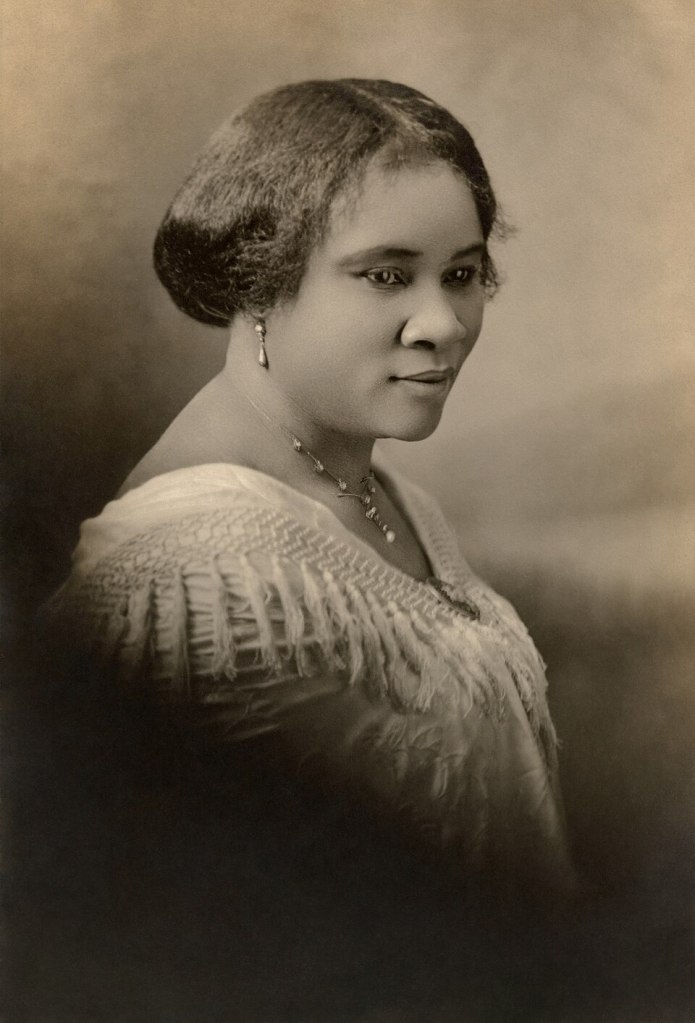
Walker’s entrepreneurial journey began under circumstances that offered next to no promise of economic advancement. After the death of her parents, Walker worked in cotton fields before eventually earning a position as a washerwomen. Similar to other African American women in the post-Reconstruction South, her opportunities for employment were limited to mostly domestic and service labor. Tyrone McKinely Freeman notes that Walker’s early life was shaped by poverty and restricted educational opportunities – conditions that were widely common among African Americans living under Jim Crow segregation.[1]
Rather than accepting these limitations, Walker identified as opportunity within a growing consumer market. During her time working as a laundress, she experienced hair loss and scalp issues cause by harsh working conditions and lack of sanitation. Ngeri Nnachi explains that many commercially available products failed to address Walker’s concerns which left a a significant gap in the market.[2] Without any obvious answers, Walker began to experiment with treatments while simultaneously gaining experience as a sales agent for other beauty companies. Through much trial and error, she developed her own products and began selling them directly to customers.
Walkers success stemmed from her understanding of marketing and product distribution. By 1906, she was established the Madam C. J. Walker Manufacturing Company and adopted a direct-sales model that emphasized personal demonstrations and building community trust. According to Nnachi, Walker continuously traveled and sold products door-to-door while offering demonstrations for potential customers to experience the products firsthand.[3] This approach distinguished her from her competitors while also building a loyal customer base within African American communities that had been often ignored by mainstream businesses.
The growth of Walker’s company reflected a broader change that was occurring within the American economy. Expanding transportation networks and national advertising created new opportunities for entrepreneurs capable of reaching specialized markets. Walker recognized that African American women represented this market and tailored her products specifically to their needs by utilizing black newspapers for advertising. In doing so, she positioned herself and her company in a rapidly expanding consumer culture. Her business demonstrated how a minority entrepreneur could capitalize on emerging economic trends despite facing discrimination.
One of Walker’s most important contributions was the creation of a nationwide network of sales agents. Throughout her company, thousands of African American women received training in beauty culture, sales and business management. Historian Kate Dossett argues that the Walker Company actually challenged traditional assumptions about Black women’s economic roles by transforming them from consumers into entrepreneurs and professionals.[4] The agents she employed were also examples of economic independence within their communities. This was an alternative path for financial stability and professional advancement that had not been available previously.
Walker consistently emphasized that business success carried broader responsibilities. In reflecting on her own humble beginnings, Walker noted, “I got my start by giving myself a start.”[5] She also believed economic success should benefit others. While her wealth continued to increase, she consistently donated to educational institutions, charitable organizations and civil rights causes. She supported institutions such as the Tuskegee Institute and helped to fund educational opportunities for students.[6] Freeman also argues that Walker viewed business ownership and philanthropy as interconnected rather than separate endeavors.[7] In Walker’s view, economic success created opportunities to strengthen African American communities.
Walker’s career exemplifies several important features of the American economy during the early 20th century. Her success reflected the expansion of consumer culture, the growing important of advertising and the increasing opportunities available through entrepreneurship. At the same time, experience highlighted the barriers faced by African Americans operating within a segregated society. This makes Walker unique in this era of American history – she built her business while confronting both racial and gender discrimination.
Madam C. J. Walker’s economic experience demonstrated just how entrepreneurship functioned as a pathway to advancement during the early 20th century despite constraints of Jim Crow America. Through her product innovation, effective marketing, building community trust and a nationwide sales network, Walker transformed personal hardship into business success while expanding opportunities for thousands of African American women.
Bibliography
Dossett, Kate. “‘I Try to Live Somewhat in Keeping with My Reputation as a Wealthy Woman’: A’Lelia Walker and the Madam C. J. Walker Manufacturing Company.” Journal of Women’s History 21, no. 2 (2009): 90–114.
Freeman, Tyrone McKinley. Madam C. J. Walker’s Gospel of Giving: Black Women’s Philanthropy During Jim Crow. Urbana: University of Illinois Press, 2020.
Nnachi, Ngeri. Madam C. J. Walker: Self-Made Millionaire. Minneapolis: Lerner Publishing Group, 2023.
[1] Tyrone McKinley Freeman, Madam C. J. Walker’s Gospel of Giving: Black Women’s Philanthropy During Jim Crow(Urbana: University of Illinois Press, 2020), 15–16.
[2] Ngeri Nnachi, Madam C. J. Walker: Self-Made Millionaire (Minneapolis: Lerner Publishing Group, 2023), 14–15.
[3] Nnachi, Madam C. J. Walker, 15–16.
[4] Kate Dossett, “‘I Try to Live Somewhat in Keeping with My Reputation as a Wealthy Woman’: A’Lelia Walker and the Madam C. J. Walker Manufacturing Company,” Journal of Women’s History 21, no. 2 (2009): 90–101.
[5] Nnachi, Madam C. J. Walker, 16.
[6] Nnachi, Madam C. J. Walker, 26–27.
[7] Freeman, Madam C. J. Walker’s Gospel of Giving, 8–10.
 Margins of History
Leave a comment